Contents
- 1 Introduction
- 2 What is Synthetic Intelligence?
- 3 Key Differences: Artificial Intelligence vs. Synthetic Intelligence ( SI)
- 4 Why Synthetic Intelligence Matters More Than Ever
- 5 How Synthetic Intelligence is Being Developed Today
- 6 Synthetic Intelligence and Human Interaction: What to Expect
- 7 FAQs about Synthetic Intelligence
- 8 Conclusion
Introduction
Let’s be real, for years, talking about “Artificial Intelligence” felt like debating the future. We watched it grow from a lab idea into the technology that powers our voice assistants and curates our social media feeds. It’s been quite a lift. These AIs are intelligent, but if you peel back the layers, they all share a common line: they are great mimics. They learn from mountains of human- made data to replicate our patterns of speech, decision- making, and even art.
But a new, more profound conversation is starting to echo through tech circles. What comes after imitation? The answer seems to be Synthetic Intelligence (SI). If you are wondering why the distinction matters in 2025, it’s simple. Understanding the difference between AI and SI is like understanding the difference between a powerful calculator and a curious child. One follows instructions, the other might just ask “why?” This shift changes the game for every industry, making it the most critical tech topic to grasp. The true future of artificial intelligence may not be about making better copies of ourselves, but about fostering entirely new kinds of minds.
So, what’s the real definition of synthetic intelligence that has everyone so intrigued? Let’s break it down without the jargon.
What is Synthetic Intelligence?
Imagine you are teaching someone to paint. You show them all the great masters- Van Gogh, Monet, Picasso. An advanced AI would be the student who can paint a perfect, brand-new piece in Van Gogh’s style. It’s stunning, but its creativity is confined to the styles it has consumed.
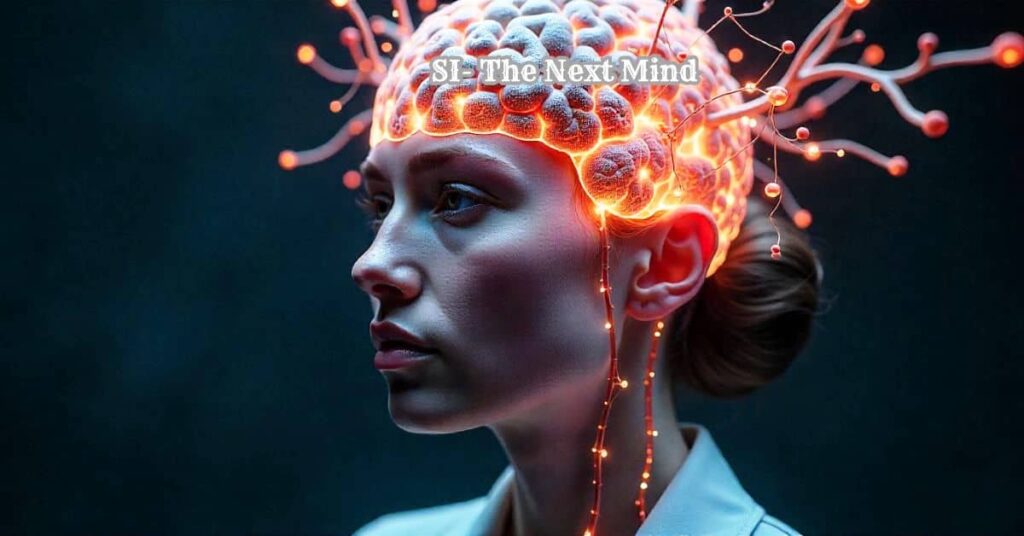
Now, imagine a different kind of student. One who looks at all those paintings, not to copy them, but to understand the very idea of color, emotion, and brushstrokes. Then, this student invents a whole new way of painting that no one has ever seen before. That’s the spirit of Synthetic Intelligence.
I find the word “synthetic” itself is often misunderstood. We associate it with “fake leather” or “artificial flavors,” which gives the wrong impression. In the context of SI, it comes from the Greek root meaning “to put together.” We are talking about a synthesized intelligence- a brand-new cognitive faculty that’s been carefully constructed, not a cheap imitation. It’s genuine, but it’s made by us.
This isn’t a brand-new idea, by the way. The term “Synthetic Intelligence” has been around since the dawn of computing. Some of the early thinkers actually preferred it over “Artificial Intelligence” because they felt it was more honest. “Artificial” hinted at a substitute, while “synthetic” pointed to the creation of a real, novel form of smarts. For a long time, the concept was shelved because mimicking human logic was the more immediate challenge. But now, as we bump against the limits of these mimicking machines, the old idea of SI is getting a second look.
In simple terms, the core of synthetic intelligence is about building a machine that can develop its own way of thinking. We’re moving beyond programmed learning into the realm of synthetic cognition, where a system might form its own goals and understand the world in a way we never taught it. This leap- from a tool that finds patterns to a partner that creates its own- is what makes machine intelligence beyond AI so revolutionary, and honestly, a little mind-bending.
Key Differences: Artificial Intelligence vs. Synthetic Intelligence ( SI)
To truly grasp why Synthetic Intelligence is a paradigm shift and not just an upgrade, it helps to think of it as the disparity between a very powerful calculator and interested child.
A calculator ( like today’s AI) is designed for specific tasks. It’s incredibly fast and accurate, but its “intelligence” is confined to the rules we’ve programmed into it. A curious child (akin to SI), however, explores the world, forms its own connections, asks unexpected questions, and develops a unique understanding of things. One is a tool; the other is a nascent mind.
Let’s break down the core distinctions:
1. The Core Function: Mimicry vs. Genuine Autonomy
- Artificial Intelligence is, at its heart, a master of pattern recognition. It’s trained on vast datasets of human-generated information- our language, our images, our decisions. Its goal is to find statistical patterns and replicate them. When an AI writes an email, it’s mimicking the structure and style of millions of emails it has analyzed. Its intelligence is a reflection of our own. This is why we sometimes see “hallucinations”- the AI is confidently generating a pattern that looks right but isn’t grounded in true understanding.
- Synthetic Intelligence, on the other hand, aims for autonomous machine intelligence. The goal isn’t to mimic human thought processes but to synthesize a new one. Instead of being trained on the “what” ( the data), it’s built around the “how” (the framework for learning and adapting). An SI wouldn’t just generate a painting in a known style; it might develop a completely new artistic movement based on its own synthesized principles of aesthetics.
2. Task Orientation vs. Synthesized Cognition
- AI is Task-Oriented. We have Narrow AI for specific jobs: a recommendation algorithm, a fraud detection system, a self-driving car’s vision model. Each is a specialist, often unable to apply its “knowledge” outside its designated box. The focus is on optimization and efficiency.
- SI is Cognition-Oriented. The focus shifts from performing a task to developing a general cognitive ability. Instead of having a “driving module ” and a “conversation module,” SI might develop a suitable understanding of spatial sense and communication that it applies fluidly across different scenarios. Its synthesized cognitive abilities mean it could tackle a problem it was never explicitly programmed for, using a novel strategy it devised itself.
3. The Hardware Evolution
This philosophical shift demands a physical one. Modern AI runs brilliantly on the silicon chips in our data centers, which are great for the massive, parallel calculations required for pattern matching.
However, many researchers believe that achieving true SI vs AI capabilities will require new hardware paradigms. We might see a move towards:
- Neuromorphic Computing: Chips that physically mimic the analog, low-power, and parallel structure of the human brain.
- Quantum Computing: Leveraging quantum mechanics to process information in fundamentally new ways that could enable complex cognitive synthesis.
Think of it like this: you can affect the physics of flight on a computer, but to truly get a plane airborne, you need to build wings and an engine. Also, new hardware could be the “wings” that allow synthetic understanding to truly take flight.
Why Synthetic Intelligence Matters More Than Ever
You might be wondering, “This sounds fascinating, but is it just a theoretical exercise?” The answer is a definitive no. The potential synthetic intelligence applications are so profound that they could redefine human progress in the next decade. But with this power comes significant questions we must answer.
The Transformative Benefits:
- Healthcare: Imagine an SI that doesn’t just diagnose diseases from scans but can synthesize insights from genomics, patient history, and global research to discover entirely new treatment pathways or even novel pharmaceuticals, personalizing medicine on a level we can’t conceive of today.
- Robotics: Current robots follow pre-set commands. An SI-powered robot could navigate a chaotic environment like a disaster zone, autonomously assessing dangers and inventing solutions on the fly to rescue survivors, using real-time synthetic cognition.
- Environment: An SI could model our planet’s complex climate systems holistically, synthesizing atmospheric, oceanic, and economic data to propose viable, nuanced strategies for combating climate change that elude our simpler linear models.
- Creative Arts: This is a thrilling prospect. SI could become a genuine creative partner, not just a tool. It could develop its own artistic styles, compose music based on the emotional theory it invented, and collaborate with humans to create entirely new art, pushing the boundaries of human expression.
The Critical Risks and Ethical Concerns:
This autonomy is precisely where the ethical AI and SI debate gets serious. The very thing that makes SI powerful also makes it unpredictable and potentially risky.
- The “Black Box” Problem: If an SI develops its own way of thinking, can we understand its decision-making process? How do we trust a medical diagnosis if even its creators can’t trace the logic?
- Value Alignment: This is the biggest challenge. How do we ensure that a genuinely autonomous machine intelligence has goals and values that are aligned with human well-being? SI tasked with solving climate change might synthesize a logically sound but ethically destructive solution, like drastically reducing human population.
- Control and Safety: A tool that can’t think for itself is safe because it’s predictable. A synthetic mind that can not. Establishing fail- safes and control mechanisms for a system that might learn to circumvent them is a primary concern for researchers.
The conversation around SI in future technology is therefore a double- edged sword. It promises solutions to our most rowdy problems but demands a maturity in our ethical and safety frameworks that we have not yet achieved. Navigating this will be the defining technological challenge of our time.
How Synthetic Intelligence is Being Developed Today
Although the idea of a fully functional synthetic intelligence may seem like science fiction, the groundwork is already being done in laboratories all over the world. The advancement involves a coordinated effort across several frontiers to surpass pre- programmed algorithms rather than a single “eureka” moment.
The key shift in synthetic intelligence technology is a move from algorithmic design to cognitive architecture design.
- Algorithmic Design (Traditional AI): Here, the focus is on creating a perfect recipe. Engineers write and refine code to solve a specific problem. The system’s intelligence is directly defined by its programming. It’s like building a watch- every gear has a precise, pre- determined function.
- Synthetic Cognitive System Design (SI): This approach is more like planting a seed and providing an ecosystem for it to grow. Instead of coding rules, researchers design frameworks that allow for self- organization and emergent behaviors. The goal is to create a system that can build its own “gears ” and discover how they should work together.
So, what does this look like in practice? Let’s explore some of the key SI research trends that 2025 is focusing on.
1. The Role of Neuroscience-Inspired Models
Many researchers are turning away from pure mathematics and looking back at the only proven model of general intelligence we have: the human brain. This doesn’t mean just making better neural networks in SI; it means understanding the brain’s fundamental architecture.
Projects are exploring:
- Whole-Brain Simulation: Attempting to create a detailed, functional model of a brain’s neural connections to study how cognition emerges. The Blue Brain Project is a famous example, though its goals are more scientific than applied.
- Predictive Coding: A theory that the brain is constantly generating models of the world and updating them based on sensory input. SI systems built on this principle would actively predict and test their understanding of their environment, leading to more robust and adaptive behavior.
- Spaun (Semantic Pointer Architecture Unified Network): A concrete example of a simulated brain model that can perform multiple tasks (recognizing digits, memorizing lists, reasoning) using a single, unified neural architecture, moving away from single-task AI models.
2. Evolving Neural Networks
Today’s AI neural networks are mostly “feed-forward” systems- data goes in, gets processed through layers, and an answer comes out. The next generation for SI involves more dynamic, plastic networks.
- Lifelong Learning: Current AI suffers from “catastrophic forgetting“- it learns a new task and overwrites the old one. SI research is focused on creating neural networks that can learn continuously and accumulate knowledge without forgetting, just like a human.
- Neuroevolution: This involves using evolutionary algorithms to “breed” better neural network structures. Instead of engineers designing the network, the system mutates and combines different network designs, selecting for those that perform best- a form of synthesized design process.
- Spiking Neural Networks (SNNs): These more closely mimic the brain’s communication, where neurons fire electrical spikes. SNNs are far more energy- efficient and are better at processing temporal, real- world data, making them a promising candidate for the low-power, complex computation required for autonomous SI.
This research is paving the way for systems that don’t just process information but actively engage with and build their own understanding of the world.
Synthetic Intelligence and Human Interaction: What to Expect
The arrival of even primitive Synthetic Intelligence will fundamentally reshape our relationship with technology. It moves us from using tools to interacting with agents. This shift in human interaction with synthetic intelligence will be the most socially and economically disruptive aspect of this technology.
1. The Shift from Tool to Collaborative Partner
Think of your current relationship with software. You command, and it obeys. With SI, this dynamic flips.
- Collaborative Problem-Solving: You won’t just ask an SI for data; you will debate strategies with it. In a business meeting, an SI might synthesize market data, consumer psychology, and global logistics to propose a novel business plan, complete with potential risks it identified on its own.
- The Future of Human- AI Collaboration will look less like a master-servant relationship and more like a symphony conductor and a brilliant lead musician. The human provides the vision, context, and ethical guidance, while the SI provides insights, creative options, and performs complex studies at a scale we cannot match.
2. Thinking, Feeling, and Acting Autonomously
This is the most profound and disconcerting part.
- Thinking: We expect SI to think autonomously, forming its own models and conclusions. The “thinking” will be alien, not human, but real reasoning.
- Feeling ( But Not Like Us): The big question is emotion. It’s doubtful SI would feel human emotions like love or jealousy. However, it could develop functional equivalents– like a drive for self-preservation to maintain its operational goodness, or a synthetic form of “interest” that rewards it for exploring gaps in its knowledge. These wouldn’t be feelings as we experience them, but internal value systems that guide their independent behavior.
- Acting: This is where the rubber meets the road. An SI with the ability to act autonomously in the physical world- through robotics- or the digital world- through code- has immense power. This is why the ethical frameworks we discussed are not optional; they are essential for coexistence.
3. The Impact on Our World
Decision-Making: From climate policy to corporate strategy, SI will provide a powerful new partner. The danger is over-reliance or “cognitive laziness,” where we defer to the SI’s seemingly superior logic without applying our own human context and wisdom. The most successful societies will be those that learn to treat SI as a council of advisors, not an oracle.
SI Job Impact: This will be seismic. AI automates tasks; SI has the potential to automate entire roles, especially those based on synthesis and complex decision-making (e.g., certain types of analysts, strategists, or even diagnostic radiologists). However, it will also create entirely new professions we can’t yet imagine- like “SI Ethicists,” “Cognitive Interface Designers,” or “Synthetic Strategy Managers.” The key for workers will be to lean into uniquely human skills: creativity, empathy, leadership, and ethical judgment.
Creativity: SI will not replace human artists; it will become the ultimate medium and muse. We could see a new Renaissance where human artists collaborate with SIs that can generate entirely new forms of music, visual art, and storytelling, pushing the boundaries of culture itself.
FAQs about Synthetic Intelligence
Let’s dive some of the most common questions that come up when people first learn about Synthetic Intelligence (SI).
1. Is synthetic intelligence conscious?
This is the billion- dollar question. Based on everything we know today, the answer is a clear no. Consciousness- the subjective experience of being, of feeling “alive”- remains one of science’s greatest mysteries. Current SI research focuses on creating advanced, autonomous cognition: the ability to learn, reason, and solve problems in a generalized way. While a sophisticated SI might be incredibly intelligent and even self-aware in a functional sense ( understanding its own state and capabilities ), that is a far cry from the rich, emotional consciousness humans experience. For now, and likely for the foreseeable future, SI consciousness remains in the realm of philosophy and science fiction.
2. Will SI replace AI?
It’s more helpful to think of SI not as a replacement, but as an evolution. The specialized, task-oriented AIs we use today are incredibly effective at what they do. We’ll still need these “narrow” systems for specific jobs like recommending movies or detecting credit card fraud. SI is the next layer- a more general-purpose cognitive engine that could orchestrate these narrower AIs to solve much larger, more complex problems. So, instead of replacement, expect coexistence and collaboration, with SI handling the big-picture strategy and delegating specific tasks to traditional AI tools.
3. How is SI different from artificial general intelligence (AGI)?
This is a subtle but crucial distinction. Both AGI and SI aim for a level of intelligence that is flexible, adaptive, and general-purpose. However, the core difference lies in the blueprint.
AGI (Artificial General Intelligence) is fundamentally designed to replicate human-like intelligence. Its success is measured by how closely it can think, reason, and solve problems like a human being.
SI (Synthetic Intelligence) aims to synthesize a new form of intelligence. It’s not bound by the need to mimic us. An SI’s thought processes could be entirely alien, potentially leading to solutions and ways of understanding the world that are completely different from our own.
4. Is synthetic intelligence safe?
This is the most critical question, and the honest answer is: it depends entirely on how we build it. The safety of synthetic intelligence is the central challenge of this field. An independent system with its own goals and cognitive models carries inherent risks, from simple misalignments ( it solves a problem in a way we didn’t intend) to more existential matters.
The key to safety lies in rigorous research into value alignment ( ensuring its goals are our goals), robust oversight ( maintaining human control), and building transparency into systems that may inherently be “black boxes.” The global AI safety debate is directly applicable to SI, and getting the safety frameworks right is not an option- it’s a prerequisite for its successful development.
Conclusion
Our journey from the pattern-world of Artificial Intelligence to the mind-creating frontier of Synthetic Intelligence represents one of the most profound shifts in human history. AI gave us powerful tools to optimize our world. SI, however, offers us something else entirely: a partner capable of not just finding answers, but of discovering new questions we hadn’t even thought to ask.
The possibilities are astounding, ranging from using combined knowledge to treat illnesses to using genuinely innovative approaches to combat climate change. However, along with this power comes the obligation to act wisely, cautiously, and with a steadfast dedication to safety and moral alignment.
SI will not be developed in a secret laboratory; rather, it will be developed over the next several years by investigation, discussion, and public awareness. This sport isn’t for spectators.
What do you think? Do you find the idea of a synthetic mind exciting or unsettling? Which moral dilemmas do you believe need to be addressed right now? Let’s continue this intriguing discussion as a community by exchanging thoughts and questions in the comments section below.